


Get a consultation
Leave a request and our manager will contact you

Slokas iela 69, Jurmala, Latvia, LV-2015

+371 242 252 16

info@bis.com.lv
Modernising production assets in industries such as heavy machinery, metals, refining, and power generation requires capital investment measured in billions of dollars. However, purchasing a complex industrial asset, such as a refinery reactor, blast furnace, or generator for a combined heat and power plant, is only one part of the undertaking.
The project phase that ultimately determines the return on this investment is the transportation, rigging, positioning, and precise installation of the equipment on its foundation. During this phase, companies must manage three major external challenges: regulatory requirements, administrative procedures, and weather-related limitations.
The impact of these challenges can be substantial. In Kazakhstan and across Central Asia, up to 85% of industrial project delays and cost overruns can be attributed to factors that were not adequately assessed during the initial planning stage. Delays caused by extended permit approvals, incomplete preparation, or planning errors can consume 20-40% of the original project schedule.
The commercial rationale is clear: companies that incorporate regulatory, administrative, and weather-related risks into their planning achieve better schedule and budget outcomes than those that respond to issues only after they occur. Managing these risks effectively should not be viewed as an administrative overhead, but as a strategic investment in protecting the project’s return on investment.
Our partner in Central Asia, 100 TONN.KZ, has been active in the industrial rigging and equipment installation market since 2002. The company has completed more than 1,500 major projects across Central Asia and Eastern Europe, building extensive practical expertise in the process. The team’s experience demonstrates that a thorough understanding of regional legislation, industry-specific requirements, and local operating conditions can reduce equipment mobilization and installation time by 1.5 to 2 times.
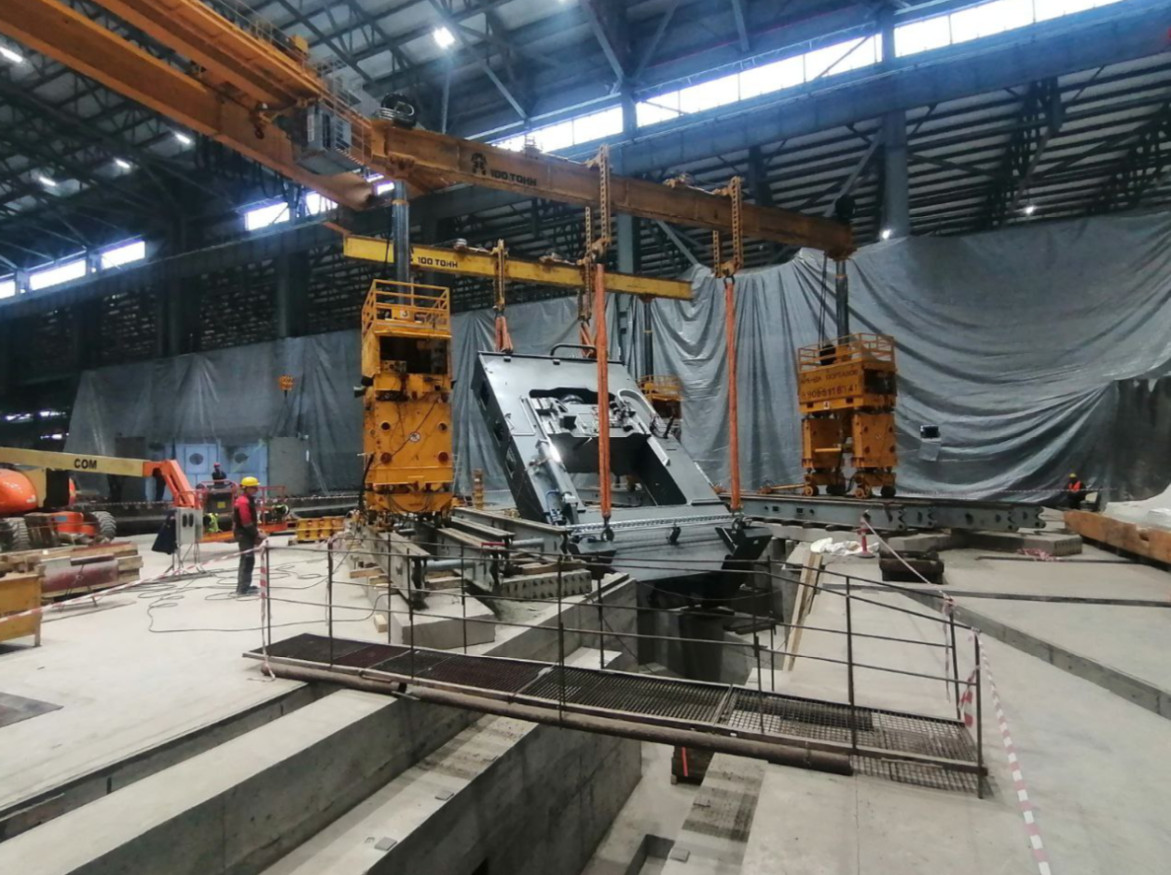
Installation at the production facility in Ekibastuz was completed in accordance with the schedule established by the German chief engineers
Rigging and installation work in heavy industry is governed by a combination of national standards and interstate technical regulations. The principal technical regulation establishing safety requirements for machinery and equipment placed on the market within the Eurasian Economic Union is the Technical Regulation of the Customs Union “On Safety of Machinery and Equipment” (TR CU 010/2011). Installation work must comply with the approved design documentation and the applicable industrial safety requirements of the Republic of Kazakhstan, including the Law of the Republic of Kazakhstan “On Civil Protection.”
The transportation and positioning of heavy and oversized loads are governed, as applicable, by the Traffic Rules of the Republic of Kazakhstan; the Technical Regulation of the Customs Union “On Safety of Wheeled Vehicles” (TR CU 018/2011); and applicable ministerial orders and permit-system rules, including Order of the Minister for Investment and Development of the Republic of Kazakhstan dated 27 February 2015 No. 206, as amended. Vehicles exceeding the applicable permissible dimensional, gross-weight or axle-load limits require a special permit. Such permits are issued by the territorial divisions of the Road Transport and Transport Control Committee of the Ministry of Transport of the Republic of Kazakhstan and, at designated customs-border crossing locations, by the state revenue authorities. If the axle load exceeds the permissible limits, it is necessary not only to assess the structural capacity of road structures, such as bridges and overpasses, but also to prepare a detailed Traffic Management Plan (TMP) approved by the traffic police.
In addition to transport regulations, industrial safety requirements impose strict controls on:
Throughout the CIS and Central Asia, contractors must demonstrate their competence through a comprehensive set of licences and certificates. In Kazakhstan, contractors must hold a Category I, II or III Licence for Construction and Installation Works, depending on the level of responsibility of the facilities being constructed or reconstructed. 100 TONN.KZ holds a Category I licence. Industrial safety specialists must also be appropriately certified. Riggers, lifting equipment operators and welders must hold valid certificates or qualifications recognised by the relevant regulatory authorities.
Although all three countries share a common Soviet engineering heritage, their regulatory systems have diverged significantly. Kazakhstan has the most digitalized, yet also the strictest regulatory control system, including the E-Licensing portal and automated weight and dimension control gantries. Uzbekistan is currently undergoing an active reform of its industrial legislation. Requirements are increasingly being aligned with international standards such as ISO and EN, although departmental regulations continue to have considerable influence. Kyrgyzstan has a less restrictive regulatory environment. However, infrastructure constraints, including mountain passes and the condition of the road network, require substantially more extensive road engineering assessments before transportation begins.
The 100 TONN.KZ Approach: To eliminate the risk of delays, our specialists begin reviewing and preparing project documentation 3–4 months before installation is scheduled to start. 100 TONN.KZ’s in-house engineering and technical department develops both the Work Execution Plan (WEP) and the Crane Operations Plan (COP).
Obtaining approvals for a heavy industrial project is always complex. In addition to dealing with government authorities, the contractor must coordinate with logistics providers, the client’s operational and technical departments and, and other contractors whose activities may affect the project.
One of the main challenges is scheduling work that requires part of the plant to be temporarily shut down. Large industrial facilities operate continuously, and shutting down a production unit for even a few hours can cost millions of dollars. For this reason, installing new equipment, connecting it to existing systems, or operating a heavy crane near active pipelines requires careful planning and approval from several departments within the client’s organization. At large companies, this approval process can take from one to four months.
Without detailed knowledge of regional requirements and established working relationships, the paperwork phase can bring a project to a standstill. Typical approval times are as follows.
Human factors and changes to requirements during project execution are recurring risks. A change of chief engineer on the client’s side or the replacement of a local inspector at a regulatory authority can trigger a complete review of previously approved engineering solutions.
The solution: permanent presence of our partner company in Kazakhstan enables us to communicate effectively with government authorities, regulatory bodies and local technical departments.
Kazakhstan and Central Asia have an extreme continental climate, with temperatures ranging from -40°C in winter to +45°C in summer. Environmental conditions are therefore critical to heavy rigging and industrial installation projects.
Suitable weather windows for outdoor installation works are extremely limited: from late April through June and from September through October. During the rest of the year, contractors face significant environmental challenges:
Compliance with installation tolerances is critical. High-precision equipment must be positioned and aligned to within ±0.1 mm. Under steep temperature gradients, steel structures are subject to significant thermal expansion. The actual length of beams or machine beds may vary by several millimetres over the course of a day, making precision alignment impossible during daylight hours in intense direct sunlight or in extreme cold.
Engineering Approach: To reduce dependence on weather conditions, we use installation methods based on hydraulic gantry systems. The 100 TONN.KZ fleet includes 10 hydraulic gantry units with a range of lifting capacities. Hydraulic gantries can be assembled inside production facilities or beneath temporary weather enclosures. Their compact footprint makes them well suited to confined spaces and areas with limited headroom, and they are far less susceptible to wind loading than conventional boom cranes. This allows the precision installation of heavy equipment weighing 100 t, 200 t and above under controlled operating conditions, even during squalls or heavy snowfall outside the building.
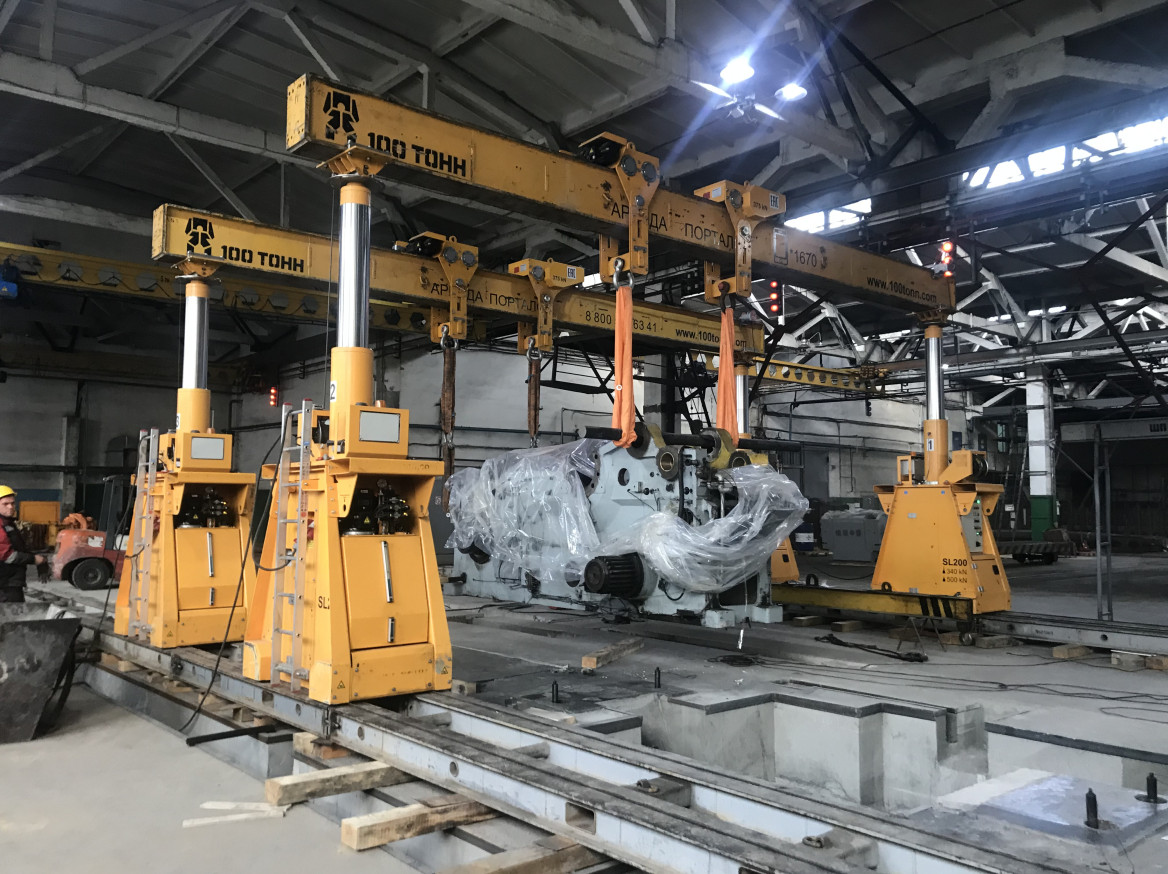
Using hydraulic gantry systems instead of cranes helps minimize dependence on seasonal conditions
Unforeseen regulatory, bureaucratic, and seasonal complications rarely occur in isolation: one inevitably triggers the next, creating a damaging domino effect.
A typical chain of events may look like this:
WEP approval is delayed by bureaucratic procedures ➔ Mobilisation is pushed back by three weeks ➔ The delay extends into the spring thaw period ➔ Seasonal road restrictions take effect ➔ Equipment remains idle, further delaying plant commissioning.
As a result, the investor is left with capital tied up in an incomplete project, lost contracts for the supply of finished products, and substantial regulatory penalties. At a major metals or petrochemical facility, even a single week of downtime can result in losses running into millions of dollars—several times the total cost of the rigging and installation work.
A case from 100 TONN.KZ: During the repair of an Italian Ficep HF2000 press at an automotive components plant in Kostanay, the 100 TONN.KZ team provided detailed planning and minimised production downtime. Because the press had previously been installed by our partner company, whose specialists had an in-depth understanding of its design. This enabled us to complete the full scope of work in strict accordance with the technical requirements: draining the oil from the system into five 200 L drums, safely disconnecting the 12 t press slide from the cylinder and moving it out on machinery skates along the gantry rails to provide access to the cylinder, and, after replacing the sealing elements, reassembling the press, refilling the system with oil and carrying out final checks to verify the completed work.
All work was completed strictly on schedule within the two-week timeframe, with zero unplanned production downtime. The client received fully operational equipment, successfully avoiding substantial financial losses that an extended production line shutdown would have caused.
To prevent cascading delays, we recommend conducting a project audit using the following checklist 4–6 months before the scheduled installation date.
Selecting a contractor solely on the basis of the lowest price for rigging services is one of the most common project mistakes.
Lower-cost contractors often lack in-house engineering capabilities, legal and regulatory support, and their own fleet of heavy lifting systems. When problems arise, the client bears the cost of their mistakes.
By selecting us, you gain a general contractor with established local infrastructure in Kazakhstan, its own fleet of specialist hydraulic lifting systems, in-house engineering, and an excellent reputation with industrial regulators.
Contact our experts today. We provide an initial project assessment covering technical feasibility, regulatory and permitting requirements, site constraints and seasonal risks. Based on this assessment, our engineers develop a technically sound, cost-effective execution plan designed to mitigate risks, delays and unforeseen costs.
We engineer solutions for heavy installation
In modern industry, the speed and precision with which capital projects are delivered directly affect a company’s competitiveness.
Every project must account for regulatory requirements, complex approval procedures, and the demanding climate of Central Asia.
Professional management of these factors transforms potential threats into a measurable competitive advantage. We provide clients with full transparency, regulatory compliance, strict adherence to engineering standards, and reliable delivery on schedule, regardless of the complexity of the approval process or the challenges posed by local weather conditions.
 Our Central Asian partner is ready to take on installation at Kazakhstan’s new mining and processing plants
Date: 24/07/2026
Kazakhstan mining industry publication Dprom.kz has featured our Central Asian partner, 100 TONN.KZ, in an article about the company’s role in supporting new mineral deposits.
Open Our Central Asian Partner 100 TONN.KZ Operates an Equipment Fleet Fully Compliant with Kazakhstan’s Regulatory Requirements
Date: 20/07/2026
The Republic of Kazakhstan enforces stringent industrial safety requirements governing the operation of lifting equipment.
Open BIS Strengthens Partnerships with Chinese Equipment Manufacturers
Date: 17/07/2026
Chinese companies are now among the key players in the global industrial equipment market. Our team has extensive experience with Chinese-manufactured machinery,
OpenLeave a request and our manager will contact you
